Work AI Tooling / Design systems · Frequence
Thinking atomically.
A production framework that cut banner design time 62%, collapsed twelve files into one, and freed a creative team to spend its hours on craft instead of file management — the blueprint that later became an AI banner builder.
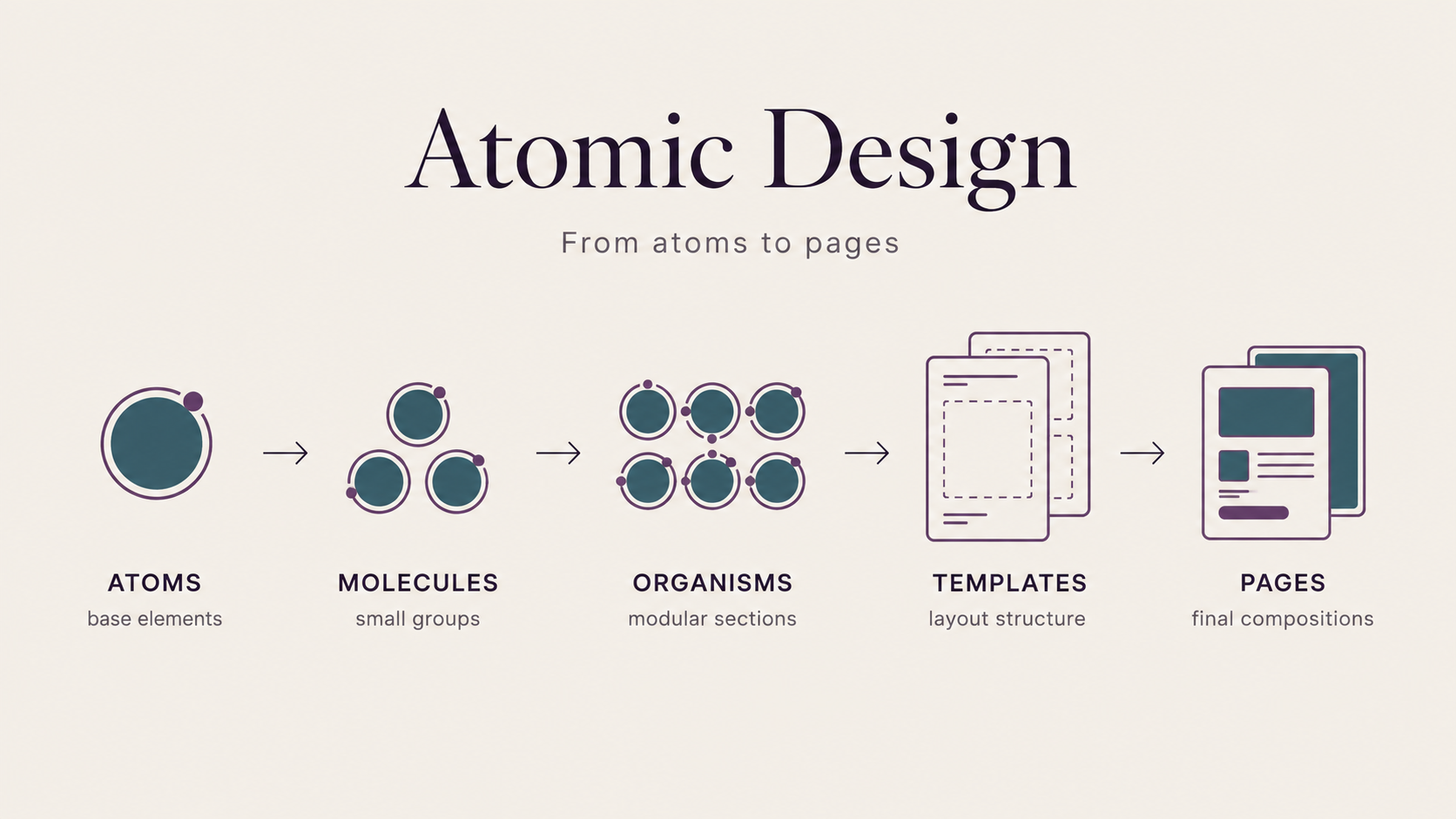
Atoms → molecules → organisms → templates → pages.
The problem I saw
In 2016, our creative team was drowning in repetitive file management. Every banner campaign meant creating and maintaining twelve separate files — six Photoshop, six Animate — across different sizes. When a client requested a change, and they always did, we opened and updated each file individually, re-exported, re-animated per size, and QA'd it all again.
A simple logo swap could take four hours. A color change meant touching every file. The process was error-prone and kept talented designers away from what they do best: creative thinking and craft.
The system I built
I designed an "atomic" framework inspired by Brad Frost's Atomic Design methodology. The core insight: break every element down to its smallest, irreducible piece — an atom — then build up from there. Change one atom and every molecule, organism, template, and page built from it updates automatically.
- Atoms — the irreducible pieces: logo, color, font, CTA, image slot, spacing.
- Molecules — atoms bonded into functional zones: header, text styling, image masks.
- Organisms — complete ad layouts; three cover all six banner sizes.
- Templates — all six sizes as artboards, structure without real content.
- Pages — the finished ad, real assets in, exported to the ad builder.
From chaos to system
The change wasn't a better file — it was a different process. Update an asset once, at the atom level, and every size follows.
Old way
- Six Photoshop + six Animate files, per campaign
- Animate each size by hand, export separately
- Every client edit repeats the whole loop
- Output: a pile of files
Atomic framework
- One atomized source file
- Export once into the Frequence Ad Builder
- An edit at the atom level propagates everywhere
- Output: a system
What changed
Beyond the numbers: brand elements stayed perfectly consistent across sizes, any designer could jump into any campaign, best-performing ads became reusable templates, and fewer files meant fewer chances to make a mistake. The hours we used to spend on file-by-file production went back into animation quality and creative thinking.
The trade-offs
No system is free. New designers needed onboarding to think atomically — it isn't intuitive coming from a traditional workflow. The framework leaned on Frequence's internal tools, which made it harder to share externally, and its reliance on heavy Adobe files meant real maintenance as software evolved. Worth it: the efficiency and creative freedom it unlocked far outweighed the cost.
What I learned
Systems thinking beats individual optimization. The instinct is to make each ad better; the breakthrough came from redesigning the whole production process. Constraints breed innovation — the soul-crushing old workflow is exactly what forced a better one. And efficiency isn't about doing more; it's about doing better: eliminating the mundane is what gives people permission to care about craft.
